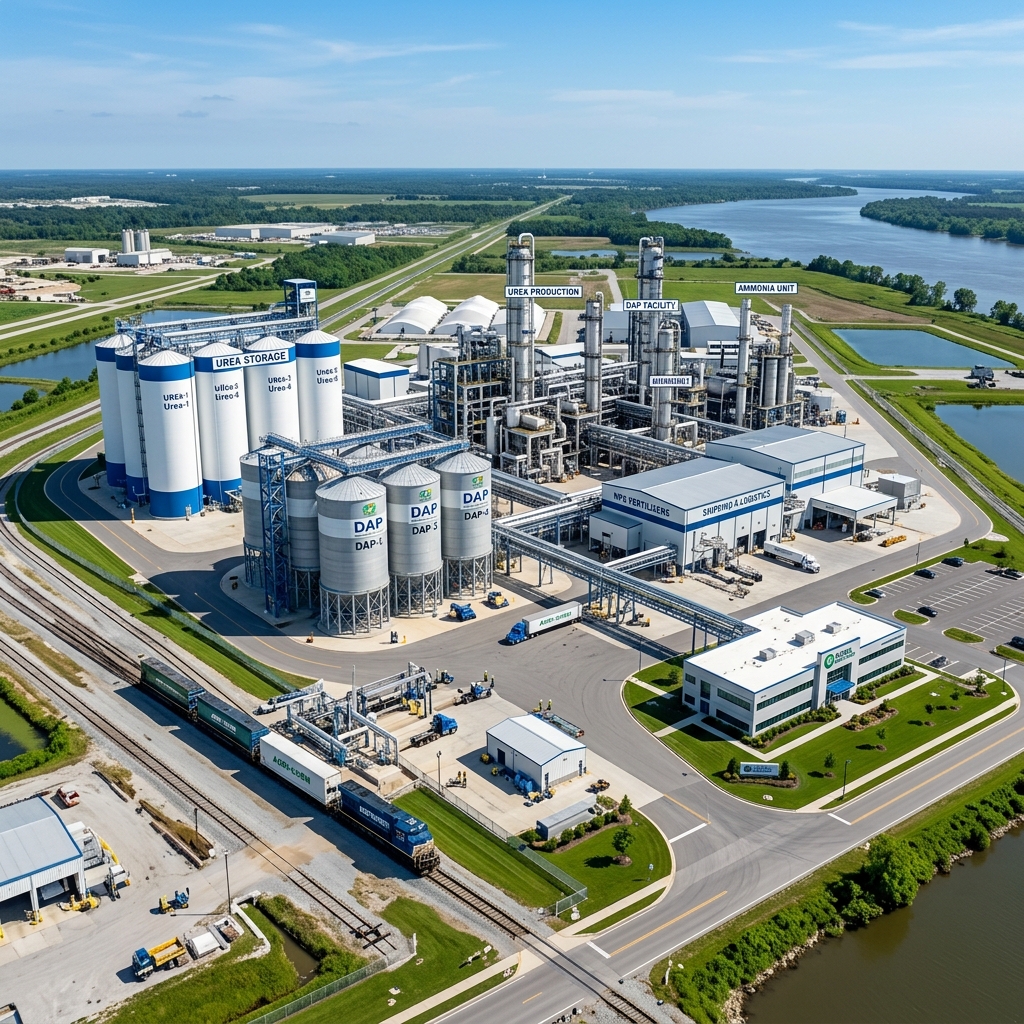
Rock Phosphate Bulk Supply: The Comprehensive B2B Procurement Guide
As the fundamental building block of the global phosphorus cycle, Rock Phosphate (RP) is more than just a mineral—it is a critical raw material for global food security and industrial chemistry. For procurement officers and fertilizer manufacturers, understanding the nuances of BPL (Bone Phosphate of Lime) content, reactivity, and logistics is essential for optimizing production costs and yield.
This guide provides a technical and commercial deep dive into sourcing Rock Phosphate in bulk, focusing on the high-demand corridors of the Middle East and North Africa (MENA) region.
1. Technical Specifications & Grades
Rock Phosphate is primarily composed of the mineral apatite. In the B2B trade, quality is dictated by the concentration of $P_2O_5$ and the presence of impurities.
Conversion Metric: BPL vs. $P_2O_5$
The industry standard often uses BPL (Bone Phosphate of Lime).- Formula: $BPL = P_2O_5 \times 2.1853$
- Standard Grades: 64% BPL (29.3% $P_2O_5$) to 72-75% BPL (33-34.3% $P_2O_5$).
Typical Technical Data Sheet (TDS)
| Parameter | Low Grade (SSP) | Standard Grade (DAP/MAP) | High Grade (Acid) |
|---|---|---|---|
| $P_2O_5$ Content | 24% - 28% | 29% - 31% | 32% - 35%+ |
| BPL Equivalent | 52% - 60% | 64% - 68% | 70% - 75%+ |
| $\text{SiO}_2$ (Silica) | 3.0% - 6.0% | 2.5% - 4.0% | < 2.5% |
| $\text{Fe}_2\text{O}_3 + \text{Al}_2\text{O}_3$ (R2O3) | < 3.0% | < 2.5% | < 1.5% |
| Cadmium (Cd) | 10–60 ppm | 5–40 ppm | < 10 ppm |
| Moisture | 3% - 5% | 2% - 4% | < 2% |
Reactive vs. Unreactive Grades
- Reactive Rock Phosphate: Characterized by high solubility in citric acid. Essential for Direct Application (DARP) in acidic soils and for high-efficiency Single Super Phosphate (SSP) production.
- Unreactive/Sedimentary: Typically requires chemical processing (acidulation) to release phosphorus for plant uptake.
2. Processing Routes: From Ore to Fertilizer
Rock Phosphate is rarely used in its raw, unground state for modern agriculture. It serves as the feedstock for several chemical pathways:
The Phosphate Production Flow
- Mining & Beneficiation: Crushing, screening, and flotation to remove silica and carbonates.
- Acidulation (The Wet Process):
- RP + Sulfuric Acid $\rightarrow$ Phosphoric Acid ($H_3PO_4$) + Gypsum.
- RP + Phosphoric Acid $\rightarrow$ Triple Super Phosphate (TSP).
- Phosphoric Acid + Ammonia $\rightarrow$ DAP (Diammonium Phosphate) or MAP (Monoammonium Phosphate).
- RP + Sulfuric Acid $\rightarrow$ Single Super Phosphate (SSP).
3. Global Supply Origins: A Strategic Comparison
The "Phosphate Triangle" in the MENA region controls the majority of the world's exportable surplus.
| Origin | Typical BPL | Key Advantages | Logistics Hub |
|---|---|---|---|
| Morocco (OCP) | 70-75% | Global price setter; massive reserves; high consistency. | Casablanca / Jorf Lasfar |
| Syria | 68-73% | Ultra-low Cadmium; high reactivity; very competitive pricing. | Tartus / Latakia |
| Jordan (JPMC) | 66-72% | High-grade standard; reliable long-term contracts. | Aqaba |
| Egypt | 60-66% | Cost-effective for SSP; abundant Mediterranean/Red Sea access. | Hamrawein / Safaga |
| Tunisia/Algeria | 62-68% | Strong established routes to Europe and Africa. | Sfax / Annaba |
Note on Syrian Origin: Syrian Rock Phosphate is highly prized by Indian and European buyers due to its low heavy metal content, making it compliant with strict EU environmental regulations regarding Cadmium in fertilizers.
4. Key Applications
Fertilizer Industry
The primary consumer (90%+ of global supply). Used to manufacture DAP, MAP, TSP, and NPK blends.Direct Application (DARP)
Ground Rock Phosphate (typically 100-200 mesh) is applied directly to acidic soils (pH < 5.5) in tropical regions (e.g., Southeast Asia, Brazil) as a slow-release phosphorus source.Animal Feed Grade
Processed into Dicalcium Phosphate (DCP) and Monocalcium Phosphate (MCP) to supplement livestock minerals.Industrial & Tech
- LFP Batteries: The rise of Lithium Iron Phosphate batteries is driving new demand for high-purity phosphoric acid derived from rock.
- Food Additives: Purified phosphoric acid for beverages and preservatives.
5. Logistics and Global Trade Routes
Efficient logistics are the difference-maker in bulk commodity trading.
- Vessel Sizes: Most B2B trades occur in Handymax (35,000–50,000 MT) or Panamax (60,000–80,000 MT) vessels to optimize freight costs per ton.
- The Syrian/Jordanian Advantage: For buyers in India and Bangladesh, sourcing from the Eastern Mediterranean (Syria) or the Red Sea (Jordan/Egypt) offers significantly shorter transit times compared to Moroccan or Florida origins.
- Black Sea Route: Crucial for supplying Eastern Europe and Central Asia via the Turkish Straits.
6. B2B Procurement Specifications
For serious importers and industrial buyers, the following terms represent the industry standard:
- Minimum Order Quantity (MOQ): 5,000 MT (Trial) | 25,000+ MT (Standard Vessel).
- HS Codes:
- 2510.10: Natural calcium phosphates, unground.
- 2510.20: Natural calcium phosphates, ground.
- Incoterms: FOB (Port of Loading) or CIF (Destination Port).
- Payment Terms:
- Irrevocable Letter of Credit (L/C) at sight.
- T/T with Bank Guarantee (BG) for established contracts.
- Documentation Required:
- Commercial Invoice & Packing List.
- Full Set Bill of Lading (Clean on Board).
- SGS/Intertek Certificate: Verification of BPL, moisture, and impurities at the loading port.
- Certificate of Origin (Form A or COO).
7. Frequently Asked Questions (FAQ)
Q1: Why is BPL 72% more expensive than BPL 68%?
Higher BPL means less "dead weight" (silica/impurities). This reduces the amount of sulfuric acid required during processing and lowers freight costs per unit of nutrient.
Q2: Can Rock Phosphate be used directly in organic farming?
Yes, raw Rock Phosphate is generally permitted in organic farming as a natural mineral source, provided it has not been chemically treated.
Q3: What is the impact of Cadmium (Cd) levels?
The EU has strict limits on Cadmium in fertilizers. Origins like Syria and Jordan typically have lower Cd levels (often < 15 ppm) compared to some West African origins, making them "premium" for the European market.
Q4: How does moisture content affect the price?
Excess moisture increases shipping weight and can cause "clumping" during discharge. Standard contracts penalize moisture levels exceeding 5%.
Q5: What is the shelf life of bulk Rock Phosphate?
As an inorganic mineral, it does not expire. However, it must be stored in dry conditions to prevent moisture absorption which complicates grinding and acidulation.
Q6: How long is the lead time for a Panamax shipment?
Generally, 30–45 days from L/C instrument opening to arrival at the destination port, depending on the origin and vessel availability.